
Body Doubling: What It Is and Why It Helps With ADHD
No time for long YouTube tutorials? Try Guidy and get it all done in minutes. It sits right on your screen and points you to exactly what to do in real time. And it works on any software or browser, in any language.
Try for free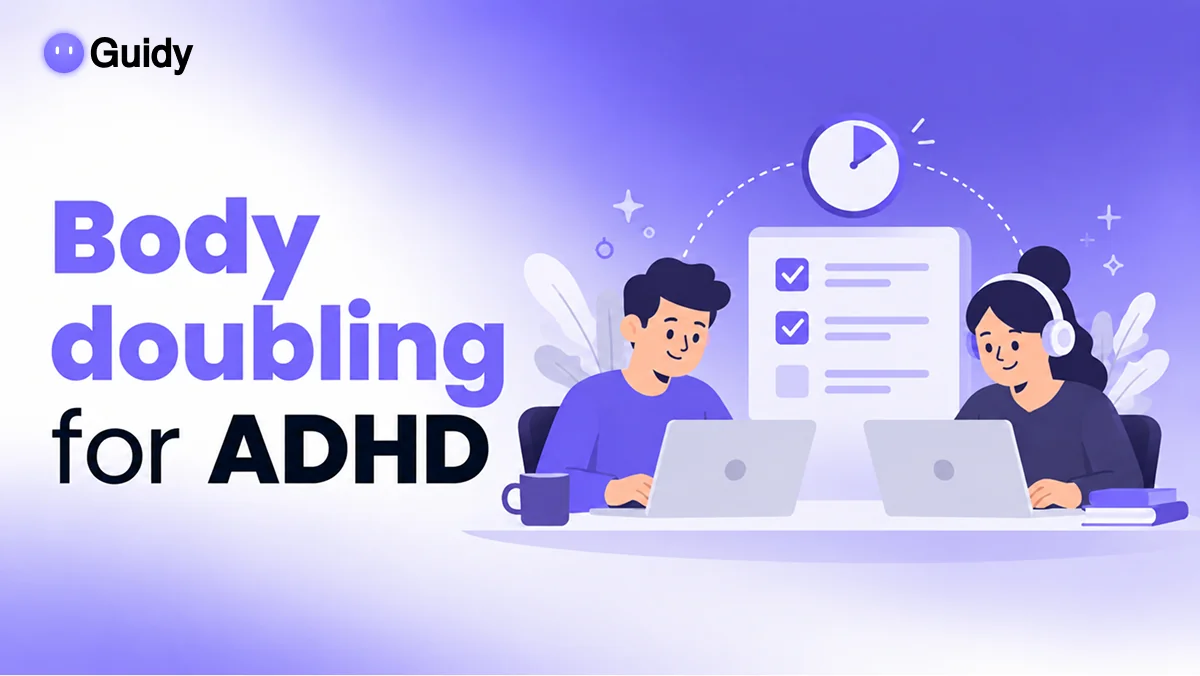
I'd been "about to start" my monthly report for two hours. Then a friend hopped on a video call to answer her own emails, we said hi, muted ourselves, and I finished the report in 40 minutes.
That's body doubling: working alongside another person, in person or virtually, to help you start a task and stay on it. You each do your own work. The other person doesn't help with yours; they're just there.
Author's note: This article is general information, not medical advice. Body doubling is an informal strategy, not a clinical treatment.
What is body doubling?
If you're asking what is body doubling, the simplest answer is "working with company." The body double is someone who's present while you do a task, usually doing their own work quietly next to you or on a call.
It's a term that grew out of ADHD communities and coaching, not a formal diagnosis-related therapy. You won't find it listed as a treatment, and there isn't a single agreed definition. But the idea is easy to recognize: plenty of people find it easier to fold laundry, file paperwork or write a report when someone else is around.
A body double can be a coworker, friend, partner, family member or a stranger on a structured coworking session.
Why does body doubling help with ADHD?
People often describe body doubling ADHD sessions as the thing that finally gets them past the starting line. Researchers haven't settled exactly why it works for some people, so I'll stick to what people commonly report rather than claim a proven mechanism.
The reasons people mention most:
- Gentle accountability. It's harder to drift to social media when someone else is visibly working.
- External structure. A session has a start and an end, which gives the task a frame.
- A clear commitment. Saying "I'm going to write the intro" out loud makes it more real.
- Less isolation. Hard tasks can feel lighter when you're not facing them alone.
Organizations such as CHADD describe ADHD as involving challenges with attention and organization, and body doubling for ADHD is one of the practical, low-cost strategies people use to work around those challenges. It works for some people and not for others, and that's fine.
In-person vs virtual body doubling
Both versions follow the same idea. The difference is mostly about convenience and comfort.
In-person body doubling means sharing a physical space. Think of working at a kitchen table with a roommate, sitting with a coworker in a quiet meeting room, or heading to a library or coffee shop where everyone's busy.
Virtual body doubling happens over video or a live stream. You join a call, say what you're working on, then mostly work in silence. It's handy if you work remotely, live alone or don't want to coordinate schedules with someone nearby.
I use both. In-person works best for chores and paperwork at home. Virtual works best for focused computer work during the day.
Body doubling apps and other options
You don't need special software, but a body doubling app can remove the scheduling hassle. Here are the main options:
- Focusmate. Probably the best-known example. You book a session, get paired with another person on video, share your goal, work, and check in at the end. It offers free and paid plans, so check its site for current limits.
- Virtual coworking apps and communities. Several services and online communities run group sessions where people work together on camera or in a shared chat room.
- A video call with a friend. The simplest version. Start a call in Zoom, Google Meet or FaceTime, agree on a time, and mute.
- "Work with me" or "study with me" streams. Many creators on YouTube and Twitch stream themselves working for hours. It's passive, but some people find it surprisingly effective.
How to try body doubling
If you've never tried body doubling, keep the first session small and specific.
- Pick one task. Something you've been putting off that fits in 25 to 50 minutes.
- Choose your double. A friend, a coworker or a session on an app.
- Say your goal out loud. "I'm going to submit my expense report," not "I'll work on admin."
- Set a timer and start. Cameras on is optional. Mics off usually helps.
- Check in at the end. Share what you got done, even if it's only half.
One thing a body double can't do is untangle a confusing piece of software. If a multi-step computer task is the real blocker, Guidy can help as a practical shortcut: it's a screen-aware desktop assistant for Windows and macOS that, when you ask, points to the next button or field on your screen and explains what to do, one step at a time. It isn't a body double or a treatment, just a way to remove some friction. You can see more on the AI for ADHD page.
When body doubling won't work
This strategy isn't for everyone, and it won't fix every focus problem. Some people find another person distracting, or feel self-conscious on camera. Others love it for a week, then get bored of it.
It also can't fix a workload that's too heavy or a task you genuinely don't understand. If you're stuck because you don't know where to begin, my guide to ADHD paralysis has more ways to break the first step down. And for everyday habits, see how to improve focus.
If focus or getting started is seriously affecting your work or life, talk to a licensed professional. Body doubling can be a helpful tool alongside that, never a replacement for it.
FAQs
Is body doubling only for people with ADHD?
No. It's popular in ADHD communities, but anyone can use it. People who work remotely, students, writers and anyone who struggles to start dull tasks often find that working alongside someone else makes it easier to begin and keep going. You don't need a diagnosis to try it.
Does virtual body doubling work as well as in person?
For many people, yes. Virtual body doubling keeps the core idea, someone else is present and working, without needing to share a room. Some people prefer in person for the stronger sense of company, while others prefer virtual sessions because they're easier to schedule. Trying both is the best way to find out.
Is Focusmate free?
Focusmate offers a free plan with a limited number of sessions, plus a paid plan for unlimited sessions. Limits and prices can change, so check Focusmate's own pricing page for the current details. A video call with a friend is a completely free alternative if you just want to test the idea first.
How long should a body doubling session be?
Most people start with sessions of 25 to 50 minutes. That's long enough to make real progress but short enough to feel manageable. If you're new to it, start shorter, and extend the session once starting feels easier. There's no rule, so pick a length you'll actually show up for.