Imposter Syndrome Examples: What It Looks Like at Work
No time for long YouTube tutorials? Try Guidy and get it all done in minutes. It sits right on your screen and points you to exactly what to do in real time. And it works on any software or browser, in any language.
Try for free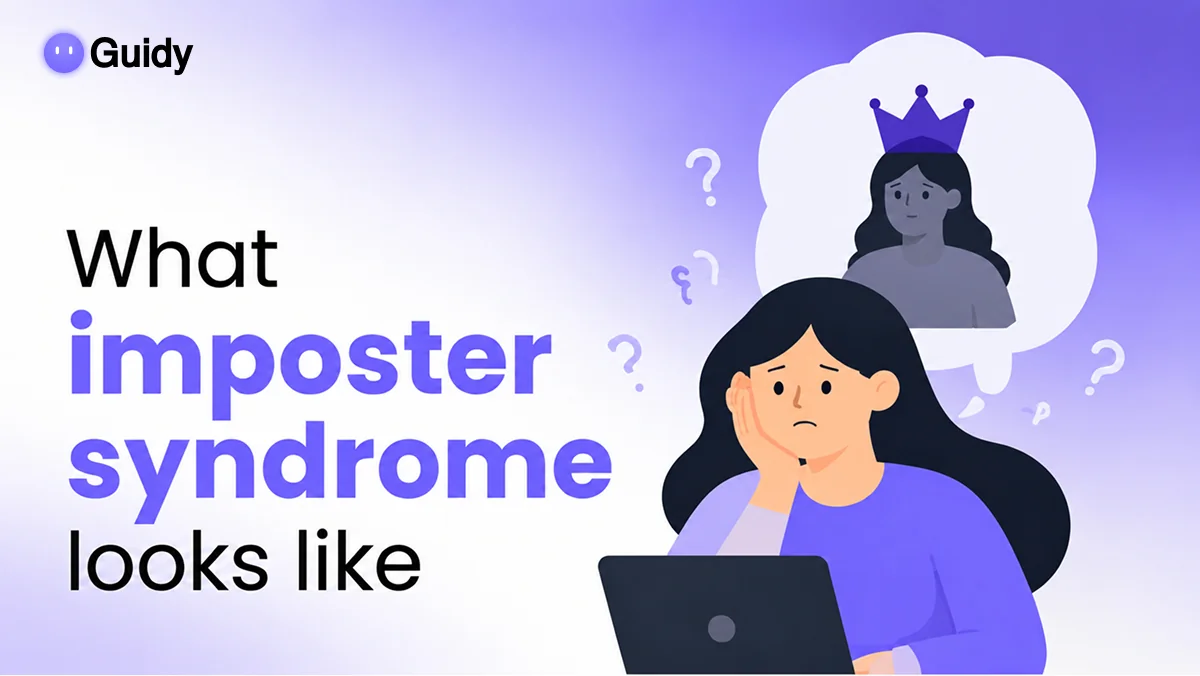
The week I got promoted, I sat in my first leadership meeting and barely spoke. I was sure someone would ask a question I couldn't answer, and the whole room would realize the promotion was a mistake.
That's one of the most common imposter syndrome examples: you've earned something, but it feels borrowed. Imposter syndrome is the persistent sense that your success is luck and you'll be "found out," even when the evidence says you're doing fine. Below are the patterns I see most often at work, and what helps with each.
What is imposter syndrome?
Imposter syndrome is a pattern of self-doubt where capable people believe they're less competent than others think they are. Psychologists Pauline Clance and Suzanne Imes first described it in 1978, calling it the "impostor phenomenon."
It's worth saying plainly: imposter syndrome is not a clinical diagnosis. It's a name for an experience, not a disorder. That matters, because it means you don't need to "cure" anything. You need to notice the pattern and respond to it differently.
What does imposter syndrome feel like?
If you're wondering what does imposter syndrome feel like, for me it's a quiet voice that discounts everything. A good result was luck. A compliment was politeness. A mistake is proof.
Physically, it can show up as tension before meetings or a knot in my stomach when my name lands in a group chat. Mentally, it's constant comparison and a habit of over-preparing "just in case." The tricky part is that it rarely feels like a syndrome. It feels like the truth.
10 imposter syndrome at work examples
These imposter syndrome at work examples come from ordinary workdays, not dramatic moments. If a few sound familiar, you're in very good company.
- After a promotion. I assume they promoted me because no one else wanted the job, not because of my work.
- In meetings. I have a good idea but stay quiet, then feel relief (and regret) when someone else says it.
- With new software. Everyone else seems to know where the setting is, and I'm too embarrassed to ask.
- Deflecting praise. Someone says "great work" and I instantly reply "oh, it was mostly the team."
- Over-preparing. I spend three hours on a 15-minute update because winging it feels dangerous.
- Crediting luck. A project goes well and I file it under timing, not skill.
- Skipping applications. I won't apply for a role unless I meet every single requirement.
- Avoiding help. I'd rather struggle alone for a day than admit I'm stuck for ten minutes.
- Dreading feedback. A calendar invite titled "quick chat" ruins my afternoon.
- Starting a new job. For the first months, I'm sure the hiring manager is quietly regretting their choice.
Example three is a sneaky one. Small software gaps (a missing menu, an unfamiliar dashboard) chip away at confidence because they happen in front of people. Practical help is genuinely useful there: Guidy is a desktop assistant for Windows and Mac that, when you ask, looks at your screen and points to the next button or setting. It won't fix the feeling, but it can remove one of the small things feeding it.
The 5 types of imposter syndrome
Dr. Valerie Young popularized five types of imposter syndrome in her book The Secret Thoughts of Successful Women. Most of us lean toward one or two. Here's each type, plus a response that actually helps.
- The Perfectionist. Anything under flawless counts as failure. Response: define "done" before you start, and ship at 90% on low-stakes work.
- The Expert. You feel you must know everything before you're allowed to speak. Response: say "I'll find out" once a week. Nobody knows everything, and admitting it builds trust.
- The Natural Genius. If something takes effort, you assume you're not good at it. Response: treat struggle as the normal sound of learning, not a verdict.
- The Soloist. Asking for help feels like proof you're a fraud. Response: ask one small question early, before you've lost a day.
- The Superhero. You measure your worth by how many roles you can carry at once. Response: pick one thing to drop or delegate this week, and notice that nothing collapses.
How to respond to imposter syndrome in the workplace
Imposter syndrome in the workplace tends to shrink when it meets evidence. These are the habits that help me most:
- Keep a wins log. One line a day about something that went well. Read it before reviews.
- Separate feelings from facts. "I feel unqualified" and "I'm unqualified" are different sentences.
- Talk about it. Saying "I feel out of my depth" to a trusted colleague often gets "me too" back.
- Take the next small step. Confidence usually follows action, not the other way round.
If you want more structure, these confidence building exercises turn those habits into a short daily routine, and this guide on how to overcome self doubt walks through it step by step.
When it isn't just imposter syndrome
Here's the honest caveat. Sometimes the doubt isn't only in your head. A manager who never gives feedback, a team that talks over you, or being the only person like you in the room can all create real pressure. In those cases, the self-doubt is a reasonable reaction, and changing your mindset alone won't fix the environment.
And if the feelings are heavy, constant, or start affecting your sleep or life outside work, please talk to someone you trust or a mental health professional. That's not a failure. It's a sensible next step.
For the smaller, practical moments, like being stuck in unfamiliar software before a meeting, Guidy's AI for imposter syndrome at work can guide you through the steps quietly. Recognizing these imposter syndrome examples in yourself is the first move. Responding with a bit more kindness is the second.
FAQs
What are some examples of imposter syndrome?
Common examples of imposter syndrome include crediting your success to luck, deflecting compliments, over-preparing for simple tasks, staying quiet in meetings, and avoiding new roles unless you meet every requirement. At work, it often shows up right after a promotion or when starting a new job, when you expect someone to discover you're not qualified.
What are the 5 types of imposter syndrome?
The five types of imposter syndrome, popularized by Dr. Valerie Young, are the Perfectionist, the Expert, the Natural Genius, the Soloist, and the Superhero (sometimes called Superwoman or Superman). Each describes a different rule you hold about competence, like needing to know everything or never asking for help.
Is imposter syndrome a mental illness?
No, imposter syndrome is not a mental illness or a clinical diagnosis. It's a widely recognized pattern of self-doubt that many capable people experience. That said, it can overlap with stress or anxiety, so if the feelings are persistent or overwhelming, talking to a mental health professional is a good idea.
How do I know if I have imposter syndrome?
You may be experiencing imposter syndrome if you regularly dismiss evidence of your own competence, fear being exposed as a fraud, and feel your achievements don't really count. A useful test is whether people you trust see your work very differently than you do. If they consistently rate you higher, that gap is a strong clue.